Empowering Youth Enterprises (EYE)

Vision: To create socially conscious youths promoting rural enterprise
Mission: Dream Big, Start Small, Start Now
Supported by: Paul Hamlyn Foundation (PHF), London, United Kingdom
How EYE Works
Phase I
Start-Up Support: initial seed capital for business set-up costs, alongside training in business canvas modelling, financial planning and enterprise management
Phase II
Growth and Expansion: additional funding linked to performance milestones, with continued mentorship to help entrepreneurs scale, diversify and strengthen their businesses
Phase III
Consolidation and Sustainability: a final funding tranche plus market-access support, focused on strengthening operations and building the foundations for long-term sustainability
Pilot Phase
2024–25 Highlights
- Seed funding disbursed to a second batch of 17 beneficiaries (including JLG members from Bakie Village) by October 2024, following a first batch of 8 beneficiaries funded in July
- Bookkeeping training for EYEC members and a dedicated bank account opened with IDBI Bank, Senapati Branch
- 15 monitoring visits conducted under a structured Monitoring & Evaluation framework
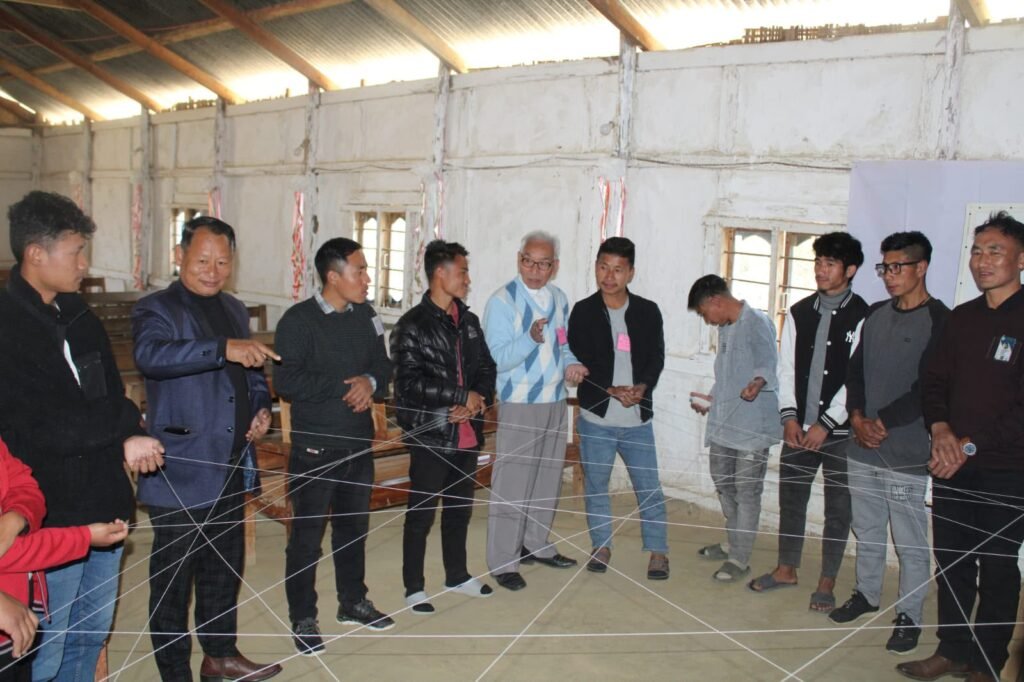
- Annual Meet held 3 November 2024 at MANEDA Conference Hall, bringing together 35 partners
- Seminar and JLG training on animal husbandry, apiculture and farming, including goat vaccination drives and a field visit to Kilam Goat Farm
- Visit from PHF representative Jennifer Liang to assess the impact of seed funding across enterprises
- 5 EYE partners onboarded to “Hillsgo,” a local delivery platform, expanding market reach
- Outreach session at Lungnila Elizabeth College of Social Work, reaching 40+ students and 5 faculty on business planning and financial literacy
- Project expanded to 4 additional villages during the year
Case Stories
Case 1
What began as a home-based kitchen producing two value-added products has grown into a food-processing enterprise offering twelve products.
The journey has not been without challenges. Financial constraints, limited infrastructure, and market access have tested the enterprise. Yet Elizabeth has continued to improve product quality, expand market reach, and build opportunities for sustainable livelihood. With guidance from MANEDA, she has strengthened her enterprise while preserving traditional methods that help keep local culture alive. Support from MANEDA also helped her access a grant under the Mission for Integrated Development of Horticulture (MIDH) from the Horticulture Departmen
Case 2
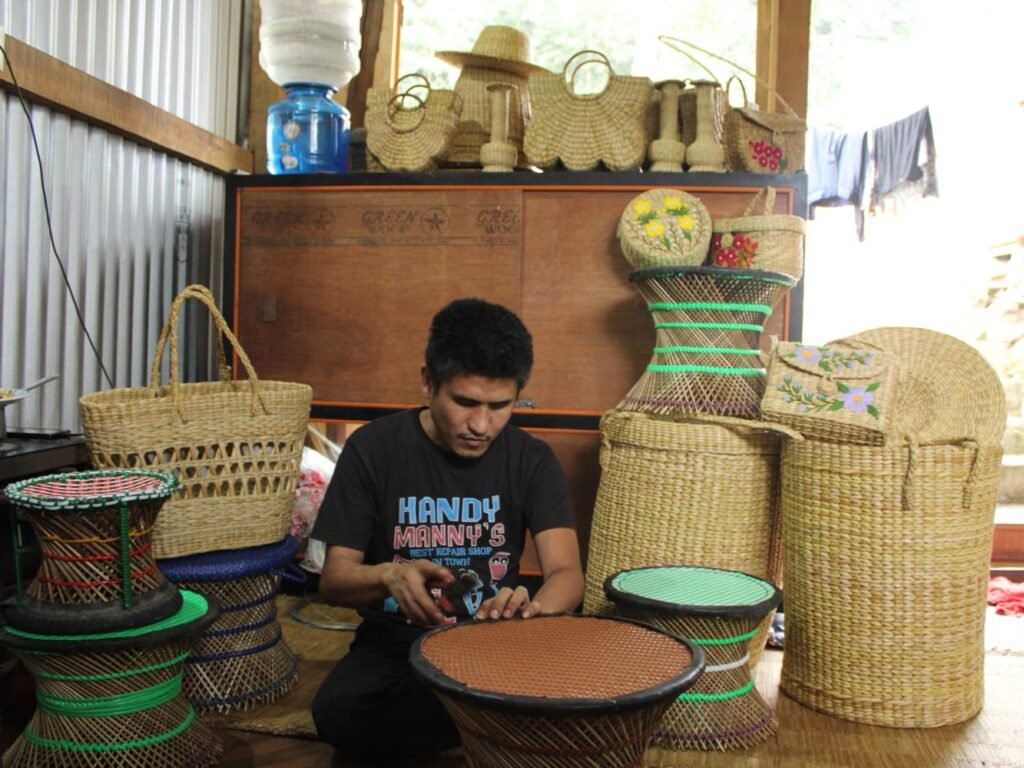
Before joining the EYE MANEDA initiative in 2022, Abishua’s life was marked by uncertainty. A visually impaired artisan and father of five living near Mt. Everest Auto Parking in Senapati, he had the skill to craft wooden stools by touch but no clear path to turn that skill into a steady livelihood. With limited income and no access to capital, he struggled to provide consistently for his large family, and his dream of running his own small enterprise felt out of reach.
Everything began to change when he became part of EYE MANEDA. Through hands-on, touch-based training, Abishua refined his craft and learned to produce stools with better finish and durability. The program did not stop at technical skills; it walked with him as he learned to think like an entrepreneur. He attended capacity-building workshops that strengthened his ability to improve product quality, engage customers, handle sales, and manage inventory in a small shop. Exposure visits and knowledge-sharing events further broadened his outlook and built his confidence.
With this support, Abishua opened a small shop under his own name, Abishua Danii Handcraft. For the first time, his work traveled beyond his immediate locality. He showcased his handcrafted stools at exhibitions and fairs in Guwahati, where his products were seen, appreciated, and purchased by new customers. These platforms helped him connect with traders and fellow artisans, expanding his market and giving him visibility not as a “visually impaired person” but as a skilled craftsperson with a growing brand.
Today, Abishua runs a recognized micro-enterprise with a fixed place of work and regular production. His household income has become more predictable, enabling him to better meet his children’s daily needs, support their education, and manage health expenses with less stress. He no longer waits for occasional work; he creates, sells, and grows his business on his own terms. In his community, he has become a quiet but powerful role model. Neighbours and other persons with disabilities now look at him and see what is possible when the right training, encouragement, and opportunity come together.
Abishua often says that EYE MANEDA gave him more than skills—it gave him dignity, identity, and hope. With continued support to upgrade his workshop, improve his shop space, and strengthen packaging and marketing, he aims to increase the quality and volume of his production, reach more customers within and outside Senapati, and secure a stable, growing income for his family. Most of all, he wants to inspire other persons with disabilities to believe that they, too, can build their own enterprises and shape their futures. His journey from uncertainty to enterprise is a living example of how disability-inclusive entrepreneurship support can transform vulnerability into leadership and turn a small craft into a sustainable livelihood.
Case 3
Orphaned at a young age in Bendramei Village, Marina
became the sole caregiver for her six younger siblings. With no financial stability, she struggled daily to meet their basic needs. Determined to break the cycle of poverty, she joined **Empowering Youth Enterprises (EYE) MANEDA** in 2022.
Through EYE’s capacity-building programs, Marina gained skills in financial literacy, animal husbandry, and marketing. In September 2022, she launched **The Local Pig Farm**, a small-scale livestock business. She began selling pigs through local butchers, retailers, and personal networks, gradually building a steady income.
With support from EYE MANEDA, she expanded her market reach using social media and participated in local exhibitions to promote her products. Her farm grew from a survival strategy into a sustainable enterprise, enabling her to support her siblings’ education and household expenses.
Today, Marina is recognized as a peer mentor in her community. She inspires other women to pursue financial independence through entrepreneurship. Her achievements include expanding her farm, increasing production, and strengthening her digital presence.
Looking ahead, Marina aims to scale up her pig farming operations, secure funding for infrastructure, and build long-term partnerships for sustainable growth. Her journey—from an orphaned caregiver to a resilient rural entrepreneur—demonstrates how opportunity, training, and perseverance can transform hardship into hope, dignity, and self-reliance for an entire family and community.